
M5Stack has launched the “AI-88502 LLM Accelerator M.2 Kit 8GB Version” based on its LLM-8850 M.2 card with a 24 TOPS Axera AX8850 SoC, and offering an alternative to the Raspberry Pi AI HAT+ 2, supporting both LLM and AI vision workloads.
The kit is comprised of the M.2 card and a Raspberry Pi-HAT 8850 board with USB PD power input for the card and Raspberry Pi 5, a 16-pin PCIe connector and 40-pin GPIO header for connection to the SBC, as well as accessories.
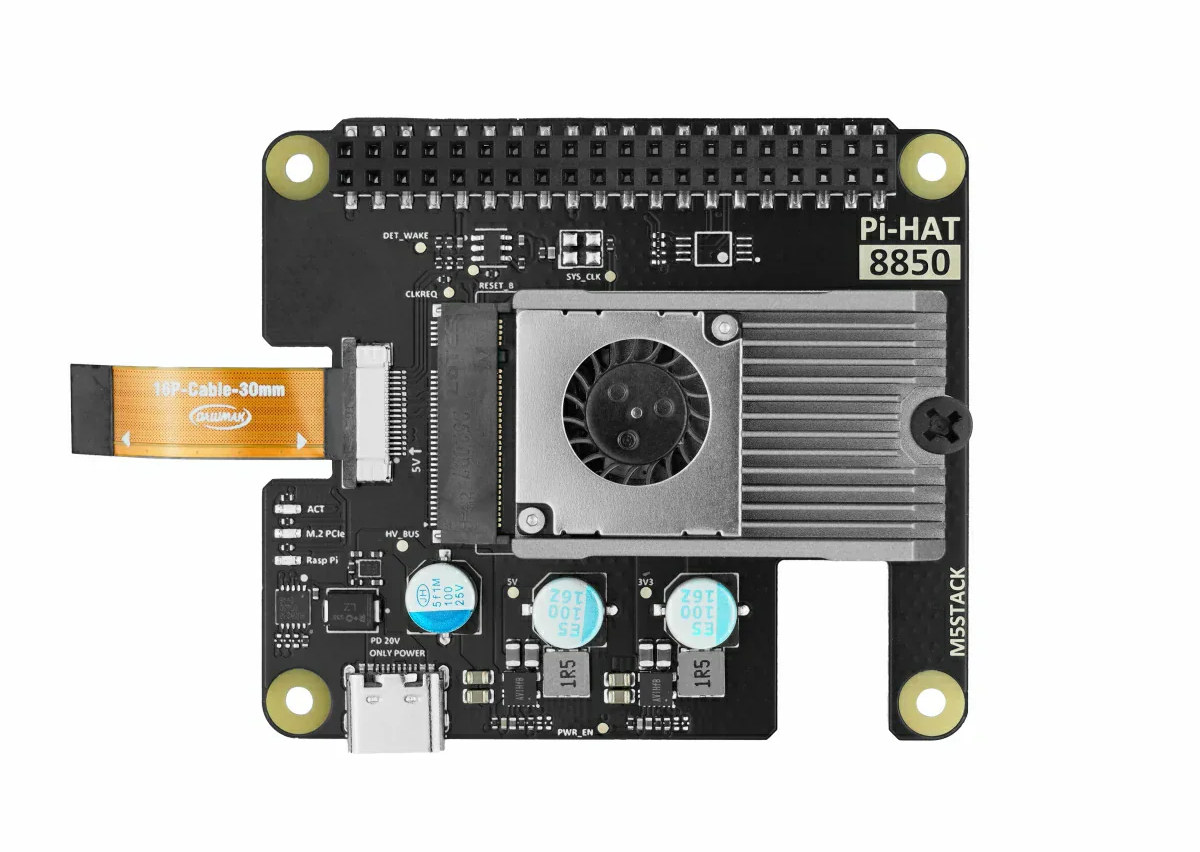
M5Stack AI-8850 LLM accelerator M.2 kit specifications:
- M5Stack LLM‑8850 M.2 card
- SoC – Axera AX8850
- CPU – Octa-core Cortex‑A55 processor at 1.7 GHz
- NPU – 24 TOPS @ INT8
- VPU
- Video Encoder – 8K @ 30 fps H.264/H.265 encoding, supports scaling / cropping
- Video Decoder – 8K @ 60 fps H.264/H.265 decoding, supports 16 channels 1080p parallel decoding, supports scaling / cropping
- Memory (two options)
- 8GB 64‑bit LPDDR4x @ 4266 Mbps
- 4GB 64-bit LPDDR4x, 4266 Mbps (not available yet)
- Storage – 32Mbit QSPI NOR Flash (for Bootloader only)
- Host Interface – PCIe 2.0 x2 via M.2 Key-M edge connector
- Cooling – Micro blower fan + integrated aluminum alloy CNC heatsink
- Power Supply – 3.3V via edge connector
- Power Consumption – Up to 7 Watts
- Dimensions – 42.6 x 24.0 x 9.7mm (M.2 M-Key 2242 form factor)
- Weight – 14.7 grams
- SoC – Axera AX8850
- Pi HAT 8850 adapter board
- Raspberry Pi Interfaces
- 16-pin FFC PCIe Gen2/3 x1 connector
- 40-pin GPIO header (just to extend the pins)
- Misc
- PCIe power, Raspberry Pi Power, and ACT LEDs
- Power
- 9V/12V/20V DC input via USB Type-C PD 3.0 port (100W protocol)
- Load Capability – Output to Raspberry Pi 5: DC 5V @ 4A; Output to M.2 accelerator card: DC 3.3V @ 6A
- DC 24V overvoltage protection
- Power Requirements – 9V @ 3A (27 Watts) for Raspberry Pi 5 and LLM-8850 card
- Raspberry Pi Interfaces
- Dimensions – 65.0 x 58.0 x 12.7mm
- Weight – 31.9 grams
- Temperature Range
- Operating – 0 to 60°C
- Full load temperature at room temperature – 70°C
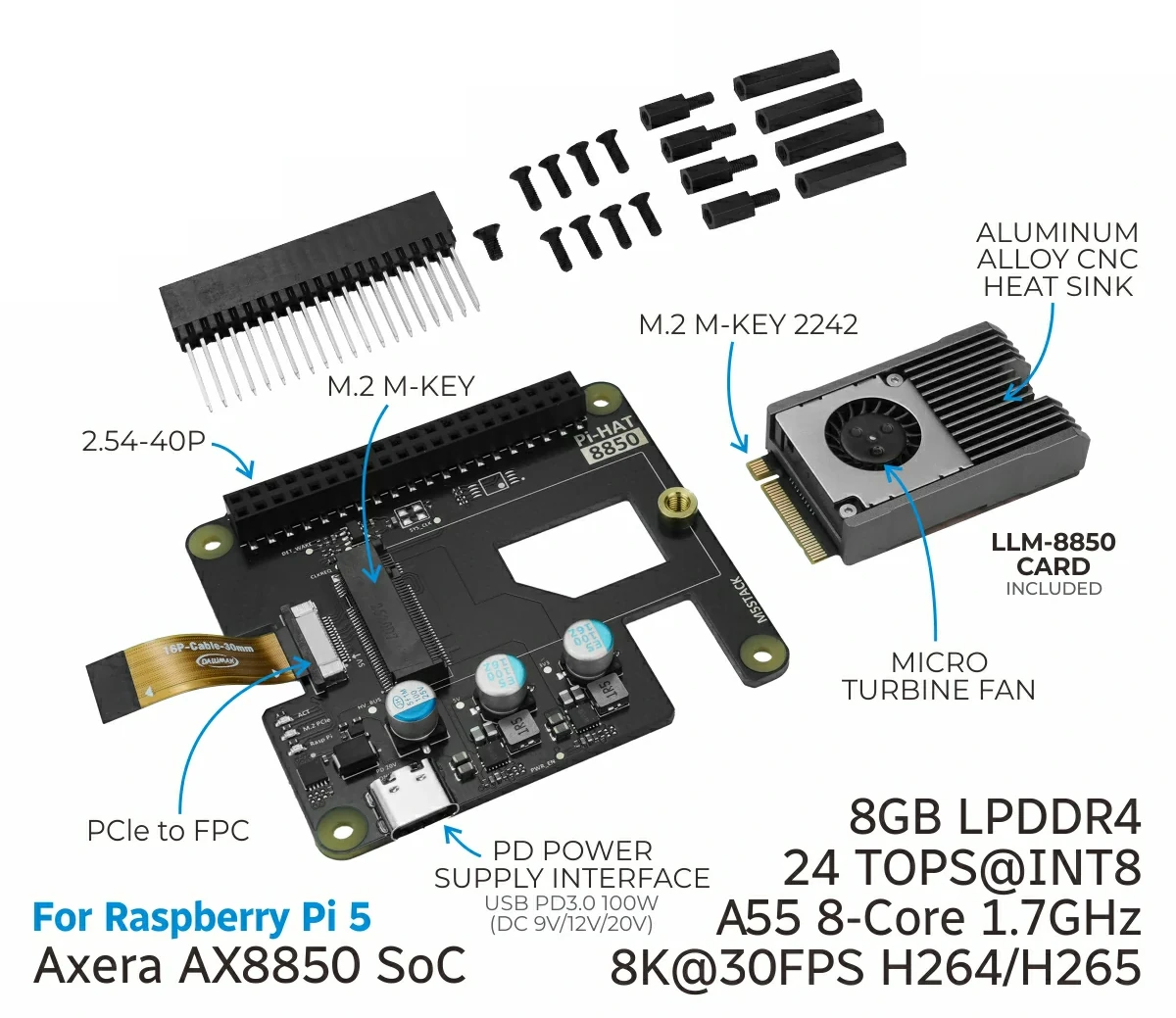
The kits include the LLM-8850 Card (8GB), the LLM-8850 PiHat, a 40-pin female header, and a screw and standoff accessory pack. The company highlights native AXCL support for one-click execution of full-stack models, including CNN, Transformer, CLIP, Whisper, Llama3.2, Qwen3, InternVL3, etc. It also supports simultaneous H.264/H.265 encode/decode for transcoding.
Once the AXCL driver is installed on your Raspberry Pi 5, you can download various demos listed in the wiki to get started. A fairly long list of models is provided:
- Vision – YOLO11, Yolo-World-V2, Yolov7-face, Depth-Anything-V2, MixFormer-V2, Real-ESRGAN, SuperResolution, RIFE
- Large Language – Qwen3-0.6B, Qwen3-1.7B, Qwen2.5-0.5B-Instruct, Qwen2.5-1.5B-Instruct, DeepSeek-R1-Distill-Qwen-1.5B, MiniCPM4-0.5B
- Multimodal – InternVL3-1B, Qwen2.5-VL-3B-Instruct, SmolVLM2-500M-Video-Instruct, LibCLIP
- Audio – Whisper, MeloTTS, SenseVoice, CosyVoice2, 3D-Speaker-MT
- Generative – lcm-lora-sdv1-5, SD1.5-LLM8850, LivePortrait
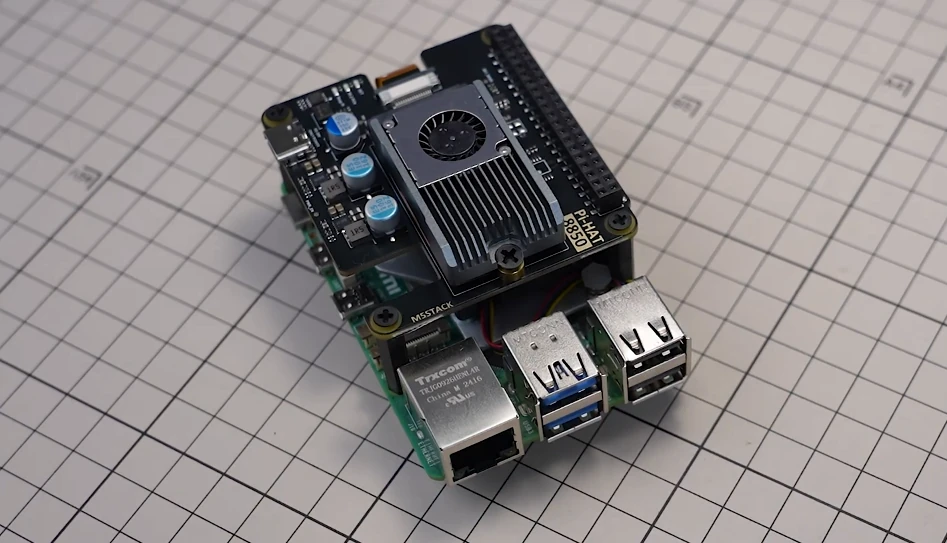
When we reviewed the Raspberry Pi AI HAT+ 2, we noticed good AI vision performance, but LLM performance was on the low side, even slower than running the model on a Raspberry Pi 5’s CPU. This is mostly because LLMs are memory-bandwidth limited, and the Hailo-10H AI accelerator on the AI HAT+ 2 is coupled with similar 8GB LPDDR4X-4267 memory as found on the Raspberry Pi 5. Since the Axera AX8850 features 8GB 64‑bit LPDDR4x @ 4266 Mbps, we should expect similar performance. For reference, I measured 6.74 tokens/s on the HAT+ 2 and 11.73 tokens/s on the CM5 devkit with Qwen2.5-1.5B-Instruct, and the wiki shows 15.03 tokens/s for the same LLM model on the Axera AX8850. So there may be some performance advantage, or the models are tweaked differently. In any case, these kinds of cards are more “LLM offloaders” than “LLM accelerators”, and if you need better performance, you may wait for the availability of Rockchip RK1820/RK1828 accelerators that promise up to 1TB/s bandwidth.
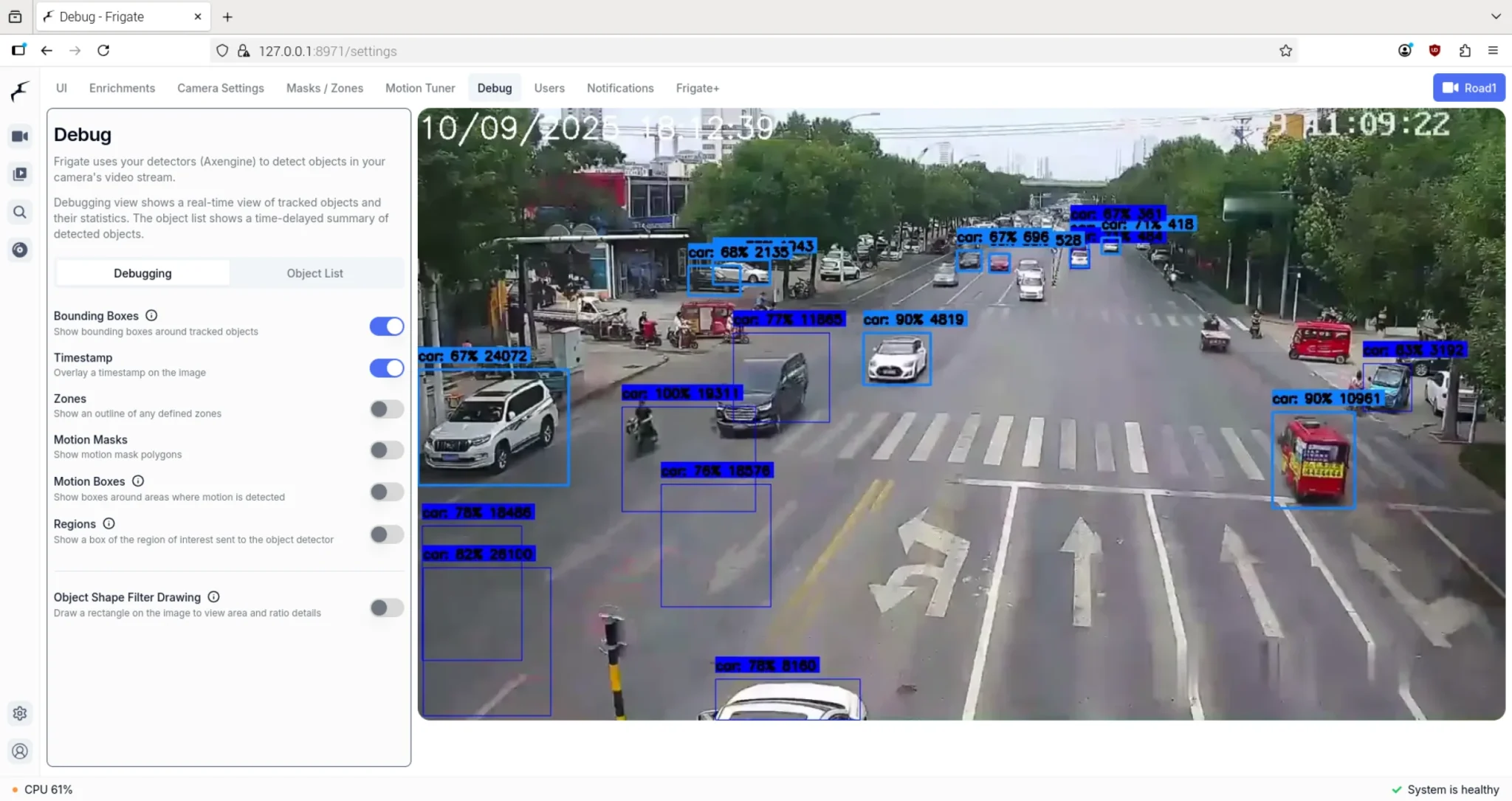
The main advantage of the LLM-8850 Kit (8GB) is probably its built-in VPU for hardware video decoding and encoding, which makes it useful for solutions like Frigate NVR. One downside is that the Axera module consumes more power (7W vs 3W) and requires active cooling, while the Hailo-10H can be passively cooled with a heatsink.
While the Raspberry Pi AI HAT+ goes for $130, the AI-8850 LLM Accelerator M.2 Kit sells at a premium at $215 on AliExpress or the M5Stack store. Maybe I’m missing something, but the LLM-8850 M.2 module is listed for $139 (from $99 in October due to increases in RAM prices), and I’m not sure what warrants the extra $76 for the HAT and accessories, unless the 100W USB PD power circuitry does add quite a lot to the cost.
Support CNX Software! Donate via cryptocurrencies, become a Patron on Patreon, or purchase goods on Amazon or Aliexpress. We also use affiliate links in articles to earn commissions if you make a purchase after clicking on those links.
Source: CNX Software
Author: Jean-Luc Aufranc (CNXSoft)